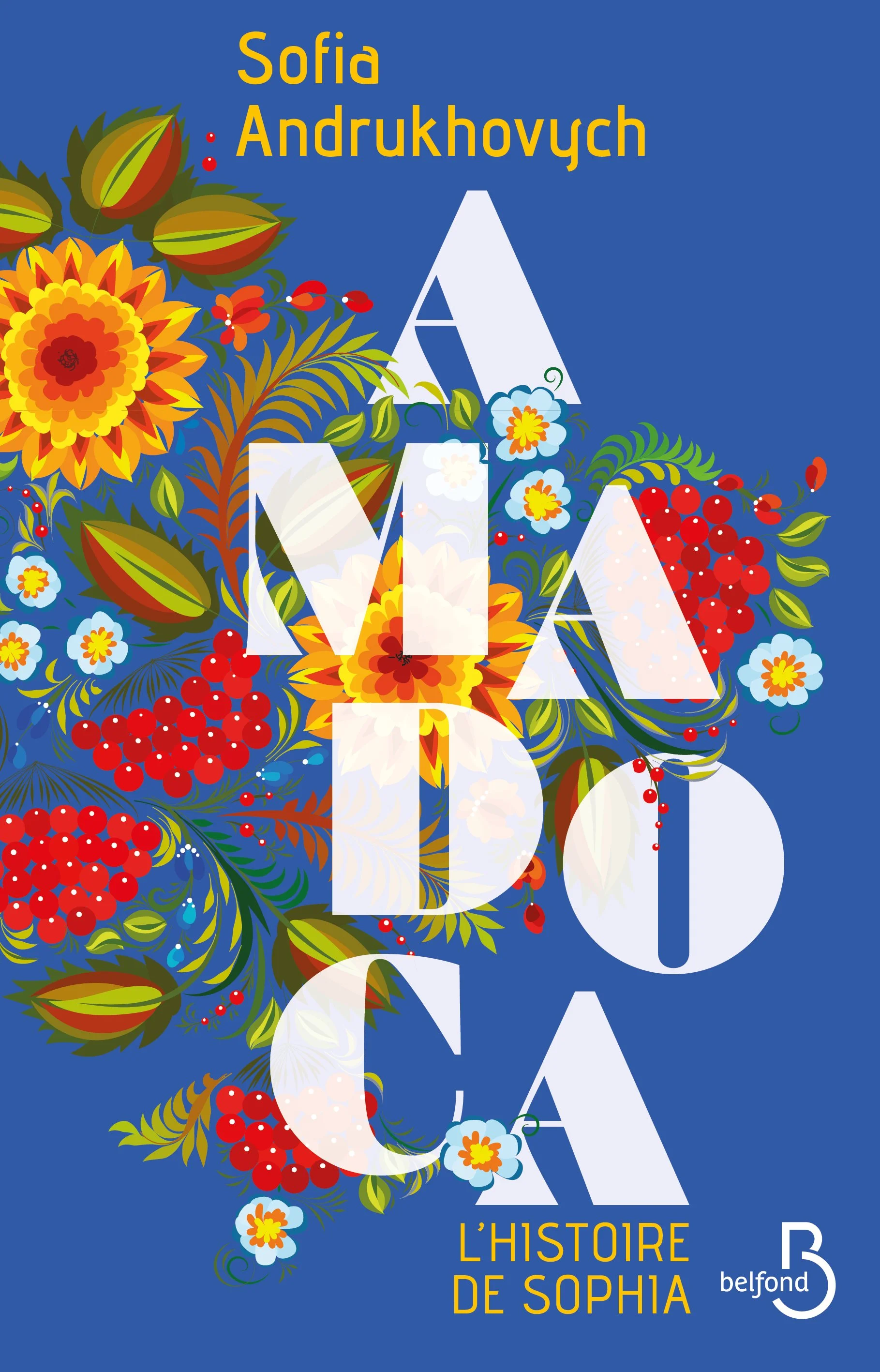
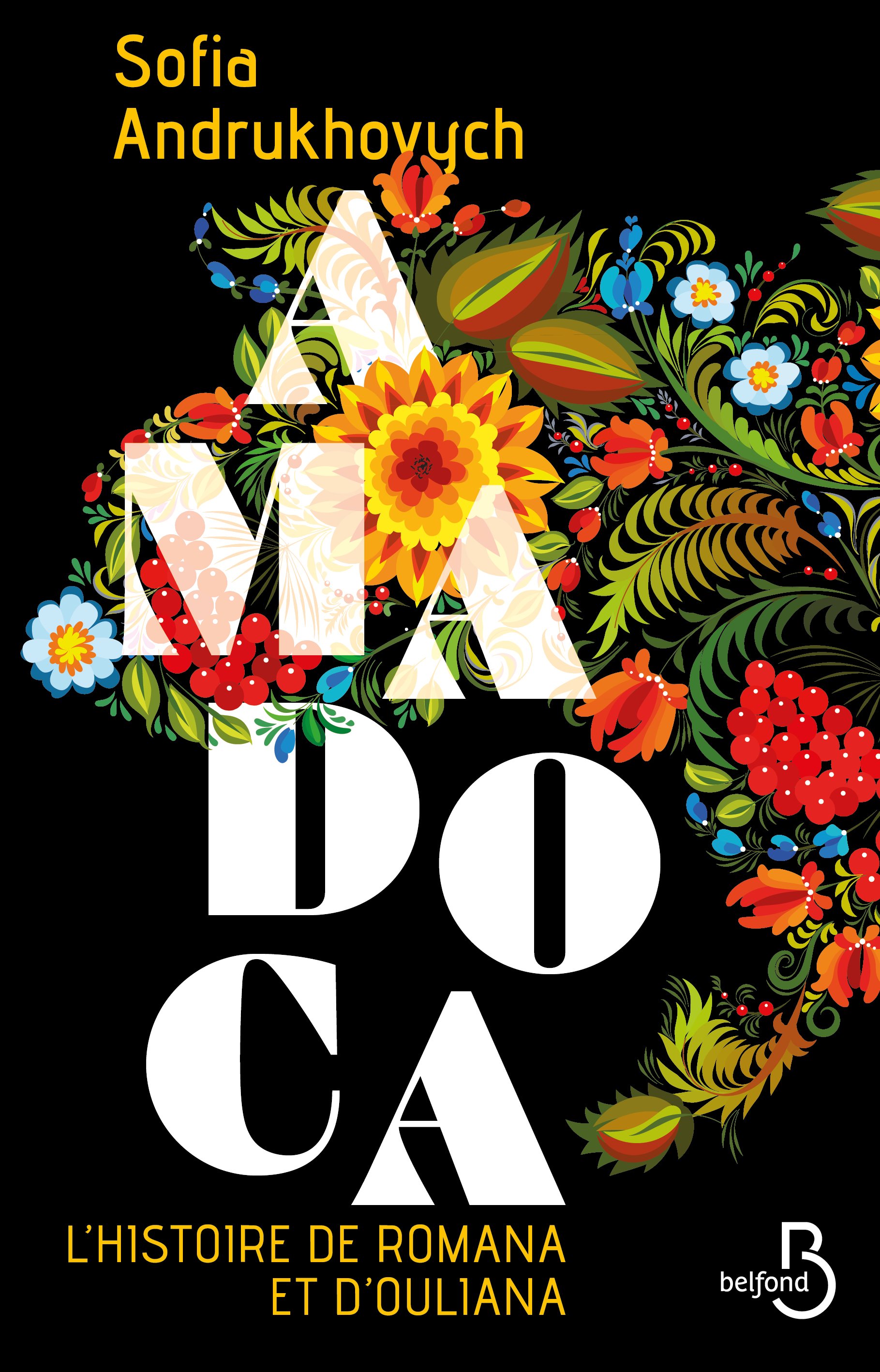
Interview with Sofia Andrukhovych
ENGLISH VERSION
by Blandine Rinkel
Did you have, from the very beginning, the idea of a massive book—both in size and in ambition—since, through the stories of your characters’ scarred faces, you’re recounting the history of Ukraine? What sources of inspiration did you draw on to write Amadoka?
The main themes of Amadoka had, in one way or another, been with me for some time even before the idea for the novel had crystallised more clearly in my mind. Even before I began to consider the possibility of writing about the Holocaust, the Second World War or the terror of the Soviet era, I had devoted a great deal of attention to these themes. But following the events of 2014–15, when I gained a certain understanding of the connection between the present and the past, when the cause-and-effect relationships became apparent, I saw how I might compose a unique history of twentieth-century Ukraine – a narrative about memory and forgetting, about trauma and what it does to us, and how it is passed down from generation to generation. And at this stage, I also began to realise that the novel I wanted to write would have to be extensive in scope: the themes, their complexity and the need for a deep immersion in the world I was creating demanded it. It was to be a difficult and long journey.
My main source of inspiration was life itself: family histories, stories told by relatives and acquaintances, filling in the gaps, coming to terms with the consequences of long-term colonisation, and reflections on identity and the ways in which we tell our own stories.
Of course, the works of Olga Tokarczuk, Milenko Jergović, Sofi Oksanen, Jaume Cabré – each of these (such diverse) authors offered me the chance to discover a unique narrative style, the possibilities and variations in how language works, how it shapes a story, and how it guides the reader into the universal human experience.
It was helpful to find countless sources of inspiration in books written in vastly different styles: in the excruciatingly painful novels of Imre Kertész, in the concise and searing texts of Hanna Krall, in the enchanting and unhurried meditations of Winfried Sebald, in the intense and shocking narrative of Jonathan Littell, and in the rich and passionate language of Oksana Zabuzhko.
Why did you choose to write a work of fiction rather than a nonfiction book based on all this material? What does the novel allow you to do that a literary investigation, for example, would not have allowed?
Creative writing is the medium that comes most naturally to me. At the same time, I suspect that fiction and non-fiction are not actually as different as we tend to think they are (provided that the author is capable of carrying out their work with the utmost honesty): both are based on observations, knowledge, facts, ideas, plots and their development, on logic and connections. It’s just that in fiction, much more is permitted; in other words, the author enjoys far greater freedom of expression. And it is much more obvious that this work is merely a version and a proposal, and should not be taken literally.
When I was working on Amadoka, what mattered most to me was not so much the depiction of historical events as the use of these events as a kind of backdrop and a means of gaining a better understanding of the human psyche and its processes, and of delving into the unconscious. Fiction provides far better access to the unconscious, to the unexpected, the unpredictable and the inexplicable. For me, it is far more important to encounter the inexplicable and the unpredictable in the process of writing than to explain the facts and recreate events. It is more interesting to observe where the narrative takes you, to follow it, guided by the logic of language rather than the logic of facts. Ultimately, the novel Amadoka is a work about storytelling, about ways of speaking, remembering and forgetting, and about the nature of stories.
In practical terms, how do you work? Over a specific period? While juggling other activities on the side? Did the book require extensive research? Since the first draft, have you mostly cut down on the narrative or, on the contrary, expanded it?
My working process has changed radically over the years of full-scale war. I am no longer able to work as I did before: reality does not allow me to be distracted from it. So I have had to learn to write in a new way, and that is why writing a novel like Amadoka would be impossible for me now. However, it is possible to write other novels.
But between 2015 and 2019, my way of life was completely different. I was able to reduce my external life to an absolute minimum – and this allowed me to immerse myself extremely deeply and consistently in the creation of a fictional world. In a sense, the fictional world of Amadoka felt more real to me at that time than my own real life, and the novel’s characters felt closer to me than the living people around me.
Yes, the novel required research. I worked in the archives, reading letters, documents, historical monographs and studies, testimonies from Holocaust victims, the diaries of those who suffered repression, and memoirs. And I spent all my time reflecting on and immersing myself in what I had read, delving into different periods, imagining the world of Amadoka: the places where the events take place, the smallest details, the connections between events, the characters’ traits, thinking through the structure of the novel, and drawing up a detailed plan and sequence of scenes.
Of course, I discarded quite a lot of what I’d written in the later stages. But, at the same time, certain parts emerged almost unexpectedly. For example, I hadn’t planned in advance the interludes concerning three figures from the 18th century: the philosopher Hryhorii Skovoroda, the sculptor Georg Pinsel, and the Jewish tzaddik Baal Shem Tov. But when they began to take shape, I felt I had to keep them, because these interludes are linked to the characters and settings of Amadoka, and moreover, they reveal a great deal about the continuity and diversity of Ukrainian culture.
Did you work in chronological order? Did you have an overall outline before working on each section (each of which is very different from the others)?
Yes, I try to work in chronological order, but it doesn’t always work out. I always have an outline, but it doesn’t really help me with the writing. Every time – and it was the same with Amadoka – I feel as though I’m stepping into complete uncertainty. Into a dark, unfamiliar space where I have to find my way around blindfolded.
The process is aided by a sort of ‘laying out’ of reality, which is why my works usually unfold slowly at the very beginning in terms of events: I need to set up the space piece by piece, to reveal the world in minute detail. Until I’ve established the setting, the plot doesn’t really take shape. Only later, when the world becomes more fully realised, do I begin to work with increasing momentum; events accelerate, and a sense of dynamism emerges. But there are also many surprises along the way: the characters start to impose their own agenda, the logic of the narrative takes me in a different direction – and it is these moments that I value most. It seems to me that when such things happen, they reveal a truth that cannot be accessed solely through facts, research and logical reasoning.
Did you write this book to investigate the connection between two major Ukrainian tragedies: the extermination of Ukrainians in the 1930s and the contemporary Russian aggression? What did you discover along the way?
For me, the subject of the Holocaust and the attitude of Ukrainian neighbours towards what the Nazis did to the Jews was no less important. Again, it was a question of the narrative: there are countless accounts from Jewish victims of that period, but it is very difficult to find testimonies from Ukrainian witnesses. Fiction allows for imagination, so I devised the following account: we see events through the eyes of a Ukrainian girl. We observe the consequences of this trauma not only on her life, but also on the lives of her son and grandson.
It was important to contrast Nazi terror with Soviet terror, to show the devastating power of these killing machines and the fragility of human life, the callousness and blindness of the regimes – and the compassion and sensitivity of individual people.
As far as non-fiction is concerned, the section on Stalin’s repressions of the 1930s comes very close to this genre. It tells the stories of real people, figures from Ukrainian cultural life in the 1920s and 1930s, and is based on facts, their biographies and archival records. Where I have allowed myself to use my own imagination and speculate, this is presented in the text in the form of questions or framed as conjecture or probabilities.
Research into this topic has once again served as a reminder that the Russian crimes, which have been taking place on a horrific scale in Ukraine for almost twelve years now, have in fact never ceased – they were simply carried out more covertly during certain periods, only to gain momentum again later. In the current war, the Russians continue to employ the very same methods of terror that they used a hundred years ago. In any case, alongside the most barbaric measures designed to physically exterminate civilians, it is of paramount importance to them to destroy Ukrainian culture: its representatives, their works, Ukrainian museums, cultural centres, and historical and architectural monuments.
With Amadoka, you bring to light a memory—both personal and collective—that has been both suppressed and reemerged, mutilated and then restored. The “phantom lake” in Amadoka serves as a metaphor, in particular, for Ukraine’s shattered memory. How, in particular, should we understand the Ukrainians’ amnesia regarding what happened during the Holocaust? And why, in your view, is it necessary today to recover that memory?
There are several reasons for the complexity of the situation regarding the memory of the Holocaust in Ukraine. On the one hand, Ukraine, as is well known, was a territory where the most horrific tragedies unfolded during turbulent times of war and catastrophe – it is not for nothing that it is referred to as the ‘blood-soaked lands’. Power changed hands so frequently here, with empires fighting one another without regard for the local population, who suffered constant abuse at the hands of various conquerors and had no state to defend their rights. Consequently, the overall level of violence endured in those territories is extremely high, and it is difficult to find a person or family who has not been affected. The human psyche usually represses such periods and passes over them in silence.
Usually, following any mass traumatic events, those who experienced them are unable to speak about them, and even the children of those involved do not yet have the words to describe them. Time must pass before the descendants of those involved can truly come to terms with these terrible experiences.
On the other hand, there is a sense of guilt: whether it be the guilt of those Ukrainians (or their relatives) who knowingly took part in the Holocaust and collaborated with the Nazis, or – far more often – the guilt of bystanders, witnesses and neighbours who were unable or unwilling to intervene or help, fearing for their own lives or those of their loved ones.
On top of all this, with the advent of Soviet rule, any discussion of the past became dangerous and forbidden if it did not fit within the official narrative of the Soviet authorities. Consequently, people learnt to remain silent about the past as a matter of principle, as this became their means of survival.
A vast number of Jews living in territories under Soviet control before the war could have been saved by spreading information about what was happening in the areas the Nazis were advancing into; yet the Soviet authorities, along with their troops and valued citizens, retreated eastwards, whilst deliberately leaving those most at risk to their fate. The Soviet authorities also contributed to the Holocaust, and this topic was particularly dangerous to discuss and analyse.
That is precisely why it is so important to talk about these terrible topics today – to recover lost and repressed memories, to piece together the scattered fragments of the whole, so that we can understand more clearly what happened. It is incredibly frightening and painful, and people usually find it difficult to acknowledge the crimes committed by those sections of society with which they identify, but this is a necessary process of coming of age and discovering one’s identity. We cannot selectively talk only about situations in which we appear as good or heroic, or as oppressed and wronged. Such selectivity is a sign of a lack of memory, which has already caused great harm.
Have you felt uncomfortable having to comment, since the release of Amadoka, on the darkest chapters of Ukrainian history, even as Ukraine is under attack by Russia? Is this a question you’re often asked? Does it wear you out?
I can’t say I feel uncomfortable when I’m asked about it. It’s a natural question and a subject I felt the need to address in my novel. At the same time, it’s a subject that’s very important to many Ukrainians today, and for most Ukrainian readers of “Amadoka”, the section on the Holocaust proved to be the most significant. Since the novel was published in 2020, I have received countless responses from readers sharing their family histories from that period: stories that are painful and horrific, of betrayal or exploitation, but also stories of rescue and sacrifice. In any case, speaking honestly and openly about this and researching those events is a need felt by many Ukrainians. There are an increasing number of professional Ukrainian historians dedicating themselves to this topic. There are an increasing number of initiatives aimed at restoring awareness of just how important Jewish culture was in these lands.
How does the fact that some Ukrainians were anti-Semitic and participated in the Holocaust alter the reality that Russia is committing horrific mass crimes on Ukrainian territory, killing more and more civilians, and terrorising people day and night – including Ukrainian Jews?
The female characters (Romana, Uliana, Sofia) in this book plunge into the swamps of Ukrainian history. How do you explain that women, especially, have such a thirst for memory and clarity?
It seems to me that all three of the novel’s main female characters are symbols of silence. All her life, Ulyana has remained silent about what happened to her in her youth: about the terrible tragedy of her own life, about how her life completely lost its meaning and became a form of torture following her wartime experiences.
Sofia Zerova, who was a real person – the wife of the Ukrainian poet Mykola Zerov (who was executed by Stalin in 1937) and later of the writer and archaeologist Viktor Petrov (who served the Soviet regime and therefore survived) – meticulously destroys all letters and documents that might reveal anything about herself, her life or her thoughts, yet carefully preserves her husbands’ archives.
Romana tells us the stories of the two previous heroines and many other characters in the narrative; it is her voice that we hear throughout the novel. Yet she remains silent about her own story and her own motives.
Women are burdened not only by the collective trauma of their experiences, but also by the myriad restrictions imposed on them by the patriarchal system. Therefore, when a woman begins to speak – as, for example, Romana does – she herself becomes a narrative, a story, a memory; she begins to embody processes that, to a large extent, transcend her as a woman and as a human being.
Perhaps one way of interpreting this novel is this: this is what happens to us, and this is what history becomes, when women remain silent, when they are forbidden to speak about themselves – about love, loss, violence and pain.
My favorite part of the entire book is perhaps the section titled “Impénétrable” in French—the second chapter of the second volume—about the « renaissance fusillée » and the story of Petrov and Zerov, their connections to Sofia. How did you conceive this section? (As I was reading about all these successive executions, I strangely thought, in terms of structure, of “The Crimes Section” from Roberto Bolaño’s 2666; was that an influence of yours?)
To my shame, I still haven’t read Bolaño’s 2666.
I hadn’t planned to compile such a comprehensive list of artists who were destroyed, but that’s how the story turned out. I wanted to imagine what might have happened to the writers and creative people of that time, what their lives might have been like under the constant oppression of terror, persecution, eavesdropping and paranoia. I sought to unravel the mystery of Viktor Petrov, his ambivalent nature: was he a treacherous scoundrel who betrayed those closest to him in order to save his own life, or was he trying to cause as little harm as possible, merely pretending to collaborate with the regime? What became of his conscience all those years he remained alive, after Stalin had destroyed most of his friends?
But as I described the setting and the era, the narrative eventually reached a point where every name mentioned became synonymous with a death sentence, an execution, imprisonment, beatings, or a shattered mind or spirit. I remember feeling stunned and crushed. I had always known what had happened back then: the systematic eradication of hundreds upon hundreds of creative people and intellectuals in the most brutal manner, simply because they were talented Ukrainians who were creating culture. But when you get this close to these stories, and each subsequent thread pulls along dozens and hundreds more, you see the sheer scale of it, this total annihilation – it’s staggering.
Imagine what would have happened if some sinister force had wiped out all the early 20th-century modernists in France and banned modernism.
What is most surprising about this whole story is that the Soviet authorities never managed to completely break the backbone of Ukrainian culture or destroy it entirely. That it keeps reviving and growing stronger time and time again.
As I have the feeling French people don’t know so much about this period, do you have any texts (translated or untranslated) or films you’d recommend to someone who, after reading Amadoka, would like to gain an even deeper understanding of what the “renaissance fusillée” in Ukraine was like?
The most iconic novels of that period were The City by Valerian Pidmohylny, The Shipwright by Yuri Yanovsky, and The Girl with the Teddy Bear by V. Domontovich (Viktor Petrov).
A great deal can be learnt about this period by studying the Boichukist art movement – a vast artistic school whose members developed monumental art, combining avant-garde practices with traditional Ukrainian art and Byzantine fresco painting.
There is a contemporary documentary film about Kharkiv artists in the 1930s, directed by Taras Tomenko – The ‘Slovo’ House. The same director later made a feature film on the same subject.
In Tout ce qui est humain (Bayard, 2023), you recount the first year of Russia’s invasion of Ukraine. You write, “War and trauma are so tedious. They have no end. Boredom and fatigue inevitably set in when one must endlessly endure pain, terror, and suffering, and when one speaks of the dead.” Do you also feel that the narrative of war is endless? How can one still believe that it can be shared? Do you still believe in that?
In order to carry on and move forward with life, we must articulate our experiences and share them. The very least that caring people – who have been fortunate enough not to have experienced the war first-hand – can do is to be willing to truly listen, to try to understand, and not to forget.
But the experiences of war are far from the only thing that makes up our lives. War cannot help but be woven into the narrative of any modern Ukrainian, because it is felt at every moment. When I answer this question, I know that Russian missile launchers will be firing missiles at my city within the hour – I’ve just received a notification about it on my phone.
Yet alongside this, everything else is happening too: different aspects of human life are brought into sharper focus, becoming more striking. I think that’s very interesting.
Absalon aims to focus on European literature and to revive the idea of a vibrant European culture that is demanding and curious about others. You, for your part, speak several languages and have also been translated into several languages. Would you say that Amadoka is a European book? What do you expect from Europe?
I think Amadoka is a European book precisely in the sense you described: as part of another European culture about which, until recently, very little was known – and this is also one of the reasons behind Russia’s war against Ukraine. At the same time, it seems to me that there is much in this novel that will resonate with readers from other countries: things that are recognisable and familiar, but expressed in a new way.
I agree: we must all make an effort to truly learn more about our neighbours and about other cultures that are unfairly overlooked, to make one another visible.
It is far easier for autocracies to absorb and destroy those whose presence they silence, those they render invisible. That is why truly seeing one another has such a profound impact.